Sunday, June 3, 2018

Ironman Boulder Prep -- 2016 vs 2018

Summary

I am writing this summary to provide a comparison between two seasons to help understand the foundation of performance, which is health, training, and general preparation.  There is good deal of similarity between the two seasons, but also some enhancements preparing for Ironman Boulder this year.  For example,

  • Going into Boulder, 2016 I had three months of reasonable heath upon which I was able to add training.  Coming into Boulder this year I have a full five months of solid training and health
  • I am currently about 8-pounds heavier than in 2016; extra weight is gained muscle mass, which has manifested in more swim speed and bike power
  • I am now swimming in the top 3-percentile of the age-group, versus 20-percentile in 2016, which means about a 5+ minute faster swim split
  • I was still able to accumulate a greater bike training load as compared to 2016
  • Also, at the same effort level, I am producing ~12 more Watts as compared to 2016, with equates to about 7-minute faster bike split
  • My running base is "deeper" now as compared to 2016
  • In 2018, to enhance late-race fitness, I included 3-4 big acute training blocks of 3-days vs only one in 2016
  • My swim, bike, and run performance during Half Ironman races in 2018 is showing significant improvement over 2016

General Health

Early-2016 was when I started noticing something was wrong with my health and engaged NourishBalanceThrive for help.  We started to peel the onion, discovering and addressing layers of issues.  May-2016 was when I started to regain some footing on my health.  Part of the intervention involved going gluten & dairy free and doing Whole30.  By June, I felt like things were moving in the right direction and my training & race performance reflected that.  Thus, going into IM-Boulder, I had three months of training on reasonable health.  Attempting to train while ill is like over-stuffing a bag -- things will overflow and the bag will burst.

In 2017, I had to completely pull the plug from training and racing; my training and racing was just not progressing well.  I went back to the Lyme doc that was treating me in 2012 and we discovered I still had two co-infections, which were likely the cause of the issues going back to 2016.  After the first 3-month treatment protocol, the more dominant of the co-infections, Babesia, had been beaten back.  The next three months killed the second, Bartonella.  Also during this time, we discovered the crawlspace in our house had three mold species that were at extremely elevated levels, which were surely not helping matters.  So, we engaged an incredible local firm to mitigate the mold, which was present throughout the house.
Toward the end of 2017, I started to feel like I could slowly resume training.  I was sleeping better, and able to add a progressively greater training load.  I started with the swim, then resumed running -- after having completely stopped running for three months.  By the end of January, I had established a training load greater than all prior seasons.  Without good health, that is not possible.  Since then, I have been able to add both intensity and volume.  Thus, coming into IM-Boulder, 2018 I have a full five months of solid training and health.  Different from 2016, my diet is far more "relaxed" now; I am enjoying my burritos and burgers, and cocktails on occasion.  I am currently about 8-pounds heavier than in 2016.  One might think that the different diet could be to blame, but I am at least as lean as 2016, which means the extra weight is gained muscle mass, which has manifested in more swim speed and bike power.

Nutritional Prep

While my diet has been far more relaxed in 2018, I have still maintained regular & frequent carb-fasted and/or cab-restricted training sessions with no carbs since the night before, including:
  • a few 18-20 mile morning runs
  • nearly every Monday morning swim/spin session (~2-hours)
  • nearly every Wednesday swim/torque-interval session (~2.5-hours)
  • each of the longer brick days, including the 100-mile ride + 5-mile run on 250kCal or carbs
So, I am perhaps even more nutritionally prepared to burn fat as compared to 2016.

Mental Training

A month prior to Kona, 2016 I started meditating with Muse.  As I note in the Kona race recap, I did not appreciate the benefits until in the midst of the race, which was perfect!  However, as I did not start this practice until later in the year, I did not have the benefit of this mental training going into Boulder-2016.  I have noticed this year that tap into the regular, relaxed breathing technique practiced during meditating during threshold interval sessions.  While I have not maintained a regular practice of meditating, I had resumed a few weeks ago.  I suspect this "refresher" may come to my aid on race day this year.  

Swim

Similar to 2016, I established a big swim block in the winter, which culminated with a 10k swim on New Years Day, 2018.  Different from 2016, I have been swimming with the "masters group" at the Y, which has surely helped my technique and speed.  I started 2016 with a 500yd time-trial time of ~7:00.  This year, I was able to reduce that time to 6:36, which represents about a 6% improvement in speed.  This improvement in swim fitness has translated into the races as well, where I am now swimming in the top 3-percentile of the age-group, versus 20-percentile in 2016.  What this means at the Ironman distance is about 5-minutes improvement in the swim.

Bike

In general, the bike training between the two seasons has been very similar.  What's new in 2018 is that I am teaching spin class twice a week now.  What that means is I am teaching a high-intensity spin class the day after my long run.  It's been tough, but I think it's helped build more bike strength.  I have also transitioned my torque intervals from a solo activity to a spin class.  I have enjoyed helping other folks get stronger too!

What is different this year is that the early season (February - April) were solely intensity focused.  Every single bike session was intensity based, including:
  • Monday: 1-hour spin (IF ~ 0.90)
  • Wednesday: 1-hr VO2max intervals (IF ~ 1.00)
  • Friday: 1-hr Threshold Intervals (IF ~ 0.90)
  • Saturday: 90-min Torque Intervals (IF ~ 0.90, but at 60RPM)
It's likely a small impact, but worth mentioning, that I started using my first road bike outfitted with PowerCranks for my sessions at home.  I was surprised at how quickly I was able to adapt to this setup and am confident it has made my pedal stroke more efficient and strong.

Also different from 2016 is that I deferred the longer bike sessions until just 6-weeks prior to IM-Boulder, where in 2018 I started 9-weeks out.  While the longer-bike phase was shortened, the number of longer rides was just one fewer than 2016 (6 vs 7).

Additionally, while I tried to keep the torque intervals throughout the season in 2016, there were only two such sessions in the day before the long rides.  However, in 2018 I have been able to do 5x torque interval sessions the day before the long rides.  These back-to-back sessions surely accumulate to additional bike strength, especially in long-course racing.

While the long ride phase was shortened, I was still able to accumulate a greater bike training load as compared to 2016.  The bike Performance Management Curve (PMC) shows I hit a peak bike bCTL of 72 (~81 in TrainingPeaks) in 2018 vs 64 (~72 in TP) in 2016.

What is also different about 2018 is more bike power at the same heart rate (HR).  That difference is clearly seen in the chart below.  For example, at 135BPM I produce 220Watts vs 208Watts (NP), in 2018 vs 2016.  To put this into Ironman bike split perspective, this 12 additional watts result in a 7-minute faster bike split on the IM-Boulder 2018 course for the same level of effort. 

Run

I ramped the running volume pretty quickly in early 2018, which allowed me to achieve and maintain a peak load for a full 12-weeks prior to IM-Boulder.  That is, I did not need to "cram" the run volume in to prep for the race this year.  In 2016, I ramped more slowly and only held the peak load for 4-weeks prior to IM-Boulder.  I think that the longer training load base will result in more robust legs for the run this year.  Also, as a result of the faster ramp I was able to get in 6x 20+ mile runs in 2018 vs 4x in 2016.

While my running base is "deeper" now as compared to 2016, I don't feel as confident in my run training as I did at this time in 2016.  I have been more fatigued for many of the longer runs, and as a result, the heart rate and pace has been depressed.  Also, the pace is about 10-seconds per mile slower at the same heart rate in training as compared to 2016.  That said, my race performance this year has surely surpassed that of 2016, including the run (see below).

Bigger Days

While IM-Boulder 2016 was a HUGE breakthrough and a near-perfect race, I still faded on the last 6-miles of the run (I slowed to an 8:22/mile pace vs 7:37/mile on the ascent).  The limit I faced was general, central fatigue.  In order to stave off that slowing, I decided to build a training plan that involved longer days than I had in 2016.  These longer days took a few different forms, including adding a run at the end of the longer bike sessions -- something I did not do in 2016.  Also, I ended up including a longer ride than I had done in 2016 -- a single 110-mile ride.  I also did a moderately "big day", where I swam 4km, rode 80-miles, then did a 1-hour heat training run later in the afternoon.  Lastly, I extended my long run to a single 22-mile run.  These various sessions resulted in a higher acute training load, which may be seen in the image below.
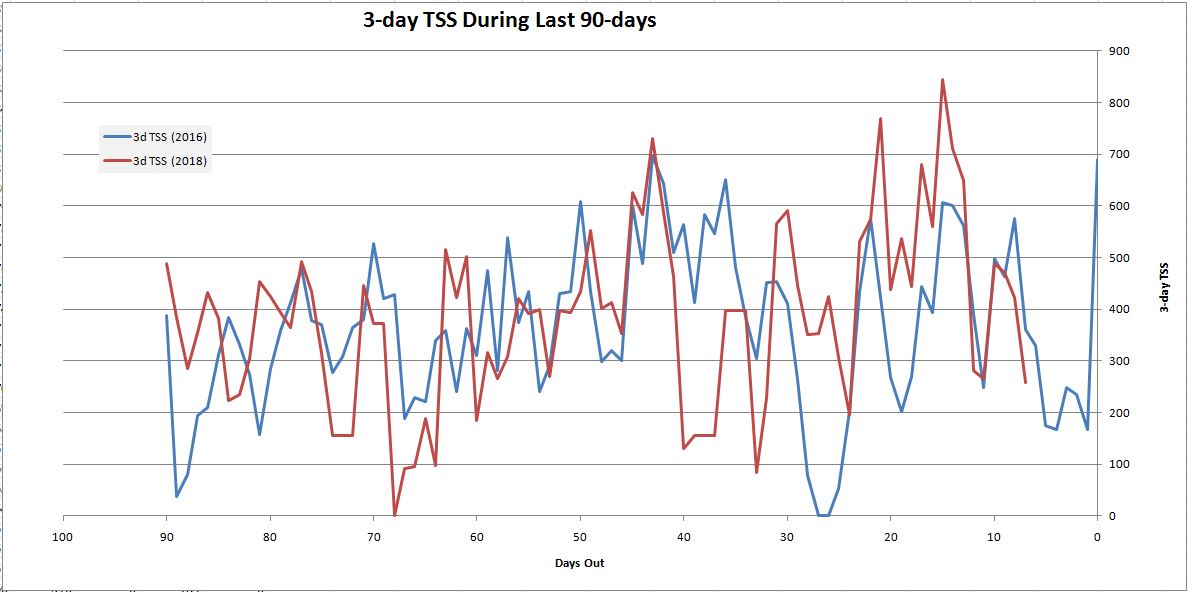

This graph shows the rolling, cumulative 3-day Training Stress Score (TSS) for the 90-day period preceding the race.  I chose 3-days because I have found that whatever I can do in 3-days of training, I can do in a single-day of racing.  The farthest-right blue point for 2016, was IM-Boulder, which was a TSS of 690.  In 2016, I achieved a TSS > 690 only once at about 6-weeks out of the race.  In 2018, I have achieved a TSS > 690 4 times, including in the last two and three weeks.  I believe these higher acute training loads, closer to the race will leave me fresher toward the end of the long day.

Heat Training

In 2016, I completed 8x heat training sessions.  This year, heat training has been challenging because it's been so mild.  Nonetheless, I have been able to log 4-5 sessions so far, including some infrared sauna time.  With a few more days remaining before I need to remove all stress, I should still be able to get some good heat exposure.

Race Performance

In 2016, I had a great race at Ocala in March, where I recorded a personal best (PB) half-IM (HIM) power on the bike.  I raced next at St George in May, where I placed 20th in my age-group, which was the best I had placed previously at that venue -- another PB.  Then, in June I won my age group at Boulder HIM (a first) by 7-minutes, with a solid run.  All signs were looking positive for IM-Boulder.

So far in 2018, I had a fair race at Ocala, where I went in quite fatigued from training.  The next weekend, I won my AG at TX70.3 by 8-minutes with a huge PB in the swim time & placing, bike power -- 10-Watts higher than in Ocala, 2016 -- and PB in the run split.  Five weeks later, I set a huge PB at St George, placing 2nd in my AG -- cutting 27-minutes off my prior time, with another PB bike power and run split on that course.  In short, my swim, bike, and run performance in 2018 is showing significant improvement over 2016.

Summary

As compared to 2016, I am swimming faster in the pool and riding with more power.  Also, I have established a higher training load for biking, and held my running base for 12-weeks.  Early season was marked with a higher level of intensity and I deferred the long bike sessions, allowing me to peak closer to the race.  I have also established some bigger days as compared to 2016.  Race performances indicate that there is even greater potential for IM-Boulder as compared to 2016.

Tuesday, May 8, 2018

2018 St George 70.3 Race Recap

Background

I signed-up for St George just a month prior, the day before TX70.3.  I was considering "St G" vs Florida, but chose St G specifically because it provided me a greater challenge and likely a greater fitness boost.  I had done the race three times prior and not been able to race well on the course -- it does NOT suit my strengths.  Both the bike and run are quite hilly, which favors athletes with high-end aerobic capacity, which I surely do not possess.  In my three prior attempts, I finished in 5:02 +/- 2-minutes.  2016 was my best performance on this course, where I placed 20th in the age-group.  Clearly, this course presents me with ample challenge.


Race Prep

After TX70.3, a month prior, training had continued well with the focus remaining on intensity.  I did, however, just barely start endurance-training with an 80-mile bike the weekend before the race.  After that ride, I started to taper for St George; I wanted to "race" rather than "train-through".  The Performance Management Chart (PMC) shown below shows that I resumed, and even ramped-up training right after TX70.3 -- hitting a Acute Training Load (ATL) of 165 and Chronic Training Load (CTL) of 112 the weekend prior.  The significance of those metrics comes in their context.  First, nearly ALL of that training load was built on intensity -- lots of short, hard sessions.  As my body disdains intensity, this training load was a challenge.  Second, I broke through an ATL plateau of ~110, heading into TX70.3.  I have noticed through a few years that plateaus present during the season and if one is patient and keeps working through them, they can be surpassed.  Third, a CTL of 112 (equivalent to 127 in TrainingPeaks/WKO) tells me I am at requisite Ironman fitness -- and without even doing any significant volume (yet).

Gear Prep & Changes


I made a few important gear changes, that I was eager to try at St G, including:
  • Front hydration -- I purchased a great little carbon fiber mount from Alden Designs to provide a better mounting platform than what was provided in the stock FSA DS1 system.  I was unhappy with how unstable it was in prior races.  In the training ride I did with the new carbon fiber mount, the system was significantly more secure.  However, the drink tube was ill-positioned (not a result of the new mount, just a design flaw in the hydration system) in that the tube would cover the power meter computer and also tend of get in the way when I went from the horns to the aero pads.  So, I tried rotating the bottle (and mount) so that the drink tube could fold-down away from the power meter computer and away from my arms.  While this configuration looked like it would accomplish my needs, it turned out to be awkward because the drink tube was too far to the back of the bike to reach well while riding.  I discovered this issue in the short ride the day before St G.  I was able to address to some extent by simply pushing the hydration system further forward on the aero-bars.

  • Nutrition bottle mount -- I also wanted to improve the access to the nutrition bottle that I had on the back of the saddle.  While this position was pretty aero, I had a hard time reaching it, especially with numb fingers, which tends to happen at St G.  So, I took the plunge and drilled holes in the bike's beam so I could mount a bottle cage on the top of the beam.  This position would be easy to access and also likely more aero than behind the saddle.  While this position was ideal in those respects, I found it actually interfered with my knees when riding out of the saddle.  It was rideable, just not ideal. It was also a bit more challenging to mount the bike in this position.  So, it's likely this bottle cage will turn into something else.
  • Wetsuit -- My friend Chris Douville has some VERY good contacts and was able to help secure me a great deal on a HUUB wetsuit, the same model as I swam in TX70.3.  I am so pleased with this new gear addition!
  • Bike Gearing -- Unlike 2016 when I rode Snow Canyon with a 11x23 cassette (and I was only able to use the 22!), I decided to spend the 5-minutes and put on a 10x27.  That was a smart move!

Race Plan

Swim: (Predicted: 29:00 to 30:30)

  • Again, my plan was to start easy and build the effort
  • As I was a ~30-minute swimmer, I was planning to seed with that group, which would put me nearer to the front of the race (a much safer position)

Bike: (Predicted: 2:25:00 to 2:32:00)

  • Pacing:
    • PSI=38 when speed < 15MPH, 45 otherwise
    • Using this plan and a tolerance of +/- 5% yields the predicted bike split in Best Bike Split 

Run: (Predicted: 1:30:30 to 1:33:30)

  • Pacing: steady effort @ target HR=155
  • I predicted the run split based on the TX 70.3 pace, but the first three miles would zap 3-minutes

Race Report

Weeks before, I decided to drive to St George rather than fly, even though that meant 19-hours of driving.  I headed out Thursday afternoon, at the tail-end of a storm and was actually a little concerned about making it over the Loveland and Vail passes.  Indeed, there was a good amount to snow, but the roads were in good condition.  I had the time and foresight to download an audiobook, which I had started reading in 2016, but had not resumed.  Wow, what a pleasure it was to listen to Matt Fitzgerald narrate his book, How Bad Do You Want It?  The book was incredibly dense, informative, and entertaining.  It was also perfectly suited for the endeavor I was undertaking.  I drove to Salina, UT the first day and was settled in bed near 9pm.  The next morning, I was on the road near 630am and rolled into St George Friday morning near 930am.  I was able to get through registration and bike drop-off by 2pm.  I was also able to check into the hotel early and kick my feet up a bit before having lunch with a new friend.  Thus, the day before the race was relaxed.

Race morning, I woke at 430am.  Breakfast consisted of black coffee, some instant, sugary oatmeal, a banana, and a bottle of with 200kCal EFS drink + 200kCal of MTC powder.  This was nearly the same drink that did not go down well on Ocala, except I swapped the UCAN for EFS drink; the latter seemed to settle much better than the UCAN/MCT concoction.  I drove the car and parked on Main Street, about 1-block from the finish.  This position served me well later in the day. 

Historically (for me at least), St G has been absolutely FRIGID in the morning.  However, race morning this year was shaping up to be a gorgeous day.  It was near 60*F and no wind.  I was able to get through the necessary prep very quickly and find a huge row of open porta-potties at the far end of the parking lot (SCORE!).  As I was waiting in line for the potty, I spotted Keish Doi.  It's great running into folks who I've known and respected for many years, especially from all over the world.

There was plenty, but not too much, time to get the final prep done before entering into the HUGE crowd of folks lining up to seed themselves for the swim.  I seeded with the 30-33 minute swimmers, which was the third group.  There were perhaps 300-400 folks ahead in the sub-27 & 27-30 minute groups.  The cannon boomed and the crowd started moving ever so slowly to the water.  They were letting three folks go at increments of about 3-seconds.  So, it took a good 10-minutes to get down to the water.  Amazingly, Keish ended up starting to my left exactly at the same time as me.

Swim (Predicted: 29:00 to 30:30 / Actual: 31:07)

  • As the seeding process let out only a few swimmers at a time, the only challenge in starting the swim was dealing with the 55*F water in the face.  While I was a bit concerned, I was able to establish a good breathing pattern within 30-seconds
  • As a result of the calm conditions, the water surface was pretty smooth.  The only chop we experienced was from some boat that must have gone by somewhat close to the course.  I was maintaining a straight line along the buoys and was able to push the pace pretty well.  Visibility was also quite good.  I was looking for some fast feet to grab onto, but not finding any of interest.  However, after making the first turn, there appeared some sort of human-amphibian -- a 26-minute swimmer -- somehow mis-seeded.  I tried to latch-on, but they were just too fast and I let them go
  • I was 6th out of 172 out of the water in my age group (top 3 percentile), which is pretty close to the performance in TX70.3

Bike (Predicted: 2:25 to 2:32 / Actual: 2:23:34)

  • Once on the bike, I started working the planned PSI, which would have me riding on average 23MPH @ 230Watts, which would be pretty comfortable.  This plan seemed too conservative on paper, but I recall in prior years not having the power I wanted when climbing Snow Canyon (mile 40-46).  Also, this plan allowed for the climbs of the course by lowering the PSI, which would -- in effect -- cap the max power near 300Watts (close to my VO2max)
  • At first, it seemed we were on a slight descent, but the speed was low.  The profile below shows it was actually a false-flat.  Once making the first climb, the speed started to return.  Wow, it was actually now quite fast!
  • I was unpleasantly surprised and disappointed with my new beam-mounted hydration that the damn bottle would move out (eject) when hitting the many bumps in the road.  So, that was a wasted effort to drill into my carbon frame.  Also, after a nice little bump at mile 20, I lost the front hydration bottle (my only water bottle) on which the power meter computer was attached.  I made the decision to let it go and keep riding.  An aide station was just 5-mile up the road and I could grab a bottle of water there and place it into the empty -- WORTHLESS -- FSA cage.  While that was a reasonable plan, the cage would not hold the water bottle.  What a POS!  So, I ended up shoving the water bottle into the front of my super-aero race suit.
  • As a result of losing the power meter, I also needed to switch from a methodical power/speed-based pacing plan to perceived effort.  I did not panic because this approach worked quite well in Kona, 2016.  After dealing with the hydration issues and getting back into the groove, we approached Snow Canyon.  I started the climb, remembering what Pete Alfino said, "pick them off one-by-one".  While I have become one of the strongest riders in many races, historically I have been passed on Snow Canyon by many a rider.  However, this year, I was the one passing.  I rode hard, but within my capacity, building the effort to the top.  Soon, we were at the summit and I was actually quite surprised.  Snow Canyon was not nearly as long and difficult as I remembered from years past.  I guess the early season fitness is working!  Maybe the better gearing helped too.
  • Since I lost the power meter, I am not able to do an actual post-mortem on the ride.  However, using BestBikeSplit and the actual split, we're able to estimate the power delivered to yield a 2:23 split.  Surprisingly, it would have taken 7% more power than planned, 252Watts (NP), to achieve that split.  Now I wonder whether my power meter is helping or hindering me.

Run (Predicted: 1:30:30 to 1:33:30 / Actual: 1:34:44)

  • I exited T2 at 10am; and doing the math, I realized I was on track to achieve my predicted times.  Of course, I just had the challenge of a half-marathon to execute!  At the time, I did not realize I was leaving T2 in first place in the AG.
  • In general, I felt like I was running better than TX70.3; legs were NOT the limiter, but the cardiovascular system.  The initial slope was totally manageable and felt pretty good.  Again, I was reminded Pete's words and started picking off runners one-by-one.  A few guys did go by me, but for the most part, I was in passing mode.  In fact, during the run, I think I may been passed by just 2-3 guys.
  • When running, I tend to go WAY inward into the hurt locker.  I pull my visor down, so as to avoid distraction from anything -- including the upcoming slopes.  I also try to avoid checking the calf (age) of anyone passing me, but that is a rather difficult.  While this strategy seems to work, it does not make for a very dynamic competitor when fellow athletes and supporters are cheering me on.  I know at least Keish & Bryan VanMeveran exchanged words -- thank you guys.  Sorry for not responding verbally.

  • Speaking of these guys, in particular; I saw them a few times during the out and back sections of the run.  I know that each has demonstrated superior running prowess over the years and they were likely closing the gap that existed.  While I was being pulled to the finish by my aspirations of an excellent race, I was also pushing in fear of being caught by these great athletes.  With these influences, I kept having to re-focus my attention to one simple task, executing my race -- running to my personal capacity.
  • As I crested the last peak, I knew it would be difficult for those guys to reach me.  I ran down the last segment as fast as I could handle and was able to pass another 3-4 guys.
  • While several guys had a better run split, I received a nice compliment after the race, when a younger guy said to me, "When I'm 50 will I be able to run like that?"
  • The run course profile is best split into three segments, with the first an ascent, the middle having a fair amount of elevation change, but net neutral, and the end, which is a fast descent.
    • Segment #1 (0 - 4.1 miles): 7:45/mile (6:53/mile xPace) @ 156BPM
    • Segment #2 (4.2 - 9 miles): 7:15/mile (7:08/mile xPace) @ 152BPM
    • Segment #3 (9 - 13.1 miles): 6:47/mile (7:22/mile xPace) @ ???BPM  (The last segment is missing accurate HR data because the chest strap kept moving down to my stomach.)

Significance

  • Mental Fitness
    • I used to silently disclaim the comment from folks who'd say superior athletic performance "is all mental".  However, I've come to realize that mental fitness is as important to reaching one's potential as athletic fitness.  Before the race, I convinced myself what I had written down for the plan was possible.  During the race, I kept my mind on executing MY plan.
    • There were a number of technical issues that presented during the race and I was able to deal with each one effectively, not allowing it to distract me from my race execution.  I recently listened to a podcast where the interviewee said something like, "assume that problems will occur during the race just be ready to handle them".
    • Lastly, I gained a great deal of confidence that I can master courses of very different profiles, from flat & windy to hilly.
  • Swim -- While I came short of my predicted time for the swim, it was still a significant improvement over my swims here in the past, which were in the 34 +/- 1-minute range. It proves again, that my swim has progressed to the top single-digit in the AG.
  • Bike power -- Again, I reached another level of power on the bike that I did not think possible.  The early season intensity has paid off -- buttressed by a foundation of good health.
  • Run -- While I came in a bit short of my predicted run time, I felt like I ran to my capacity.  Further, based on the pace & heart rate, it appears my Ironman-effort run pace is currently a 7:34/mile, after riding 56-miles @ 252Watts.  To achieve my goals at Ironman Boulder, need to run a 7:30/mile pace, after riding 2x as long, but at a significantly lower power.  I believe this performance level is within reach. 
  • Overall, I lopped-off a whopping 27-minutes (~9%) from my prior times and achieved a significant placing improvement (2nd vs 20th).  One could expect such improvement from a "rookie", but surely not from a veteran.
  • Lastly, in 2016 I placed 20th in the AG at St G, and three months later went 9:11 at Ironman Boulder, and later in the year placed 20th in the AG at Kona.  If the performance at St G is a measure of improvement, it looks quite likely that I can achieve my goals for the second half of the season (subject to coming posts).

Thursday, May 3, 2018

2018 TX70.3 Race Recap


Background

Yes, it's almost 4-weeks since the subject race and here, sitting in a cheap motel room in Salina Utah, two days away from my next race.  I've been busy: working, training, family, etc.  Regardless, I wanted to get these thoughts down before they leave my head forever, as these recaps help me understand what works well for me -- and, I hope, help others.

TX 70.3 was my first "A" race in nearly a year.  While I had high hopes for 2017, I had to pull the plug on the season after the second race (Santa Rosa 70.3 in May-2017).  While there were aspects of that race that showed promise, it was clear going into the race, during, and after that something was wrong; my health was in a tailspin.  As a result of the worsening health issues (subject of another post), I had to drop one of the spin classes I was teaching and completely stopped running.

Fortunately, after a great deal of targeted interventions, I regained my health during last winter, which allowed me to start training again.  After a solid four months of training, I am in near Ironman fitness.  What is unusual though, is that I seem to be 10-15 pounds heavier than in 2016.  While some of that is fat, I am currently pretty lean.  It's pretty clear I have added about 10-pounds of muscle mass in the last two years.  Nearly at age 50 and NOT lifting weights, I find this fact amazing.

TX70.3 Race Prep

Overall

As my health was showing signs of improvement in the winter of 2017, I set the goal of ramping my swim volume to a point where I could do 10k on New Years day.  During October through December, we ramped swim volume to prep for that big day.  Since then, I have kept 3-4 swims per week, with 2-3 with the "masters" group at the Y.  After a full 3-4 months completely off running in 2017, I did not start running again until the last week of December.  However, I was able to ramp quickly and have averaged between 40-50 miles per week since January.  Biking was limited to two sessions per week until mid-February, when I added two additional sessions.

With the exception of a weekly long run, during February and March every day had an intensity session.  The schedule below was typical during that 8 week period.

In addition to the intensity, I was able to maintain a very consistent training schedule and hold to "the  plan".  I do NOT do the traditional 3-weeks on, followed by a planned recovery week.  Rather, I train day-in day-out; when I am tired and/or not hitting the planned pace or power, I back-off.  The image below shows this consistency, with the dark days as being the only ones without biking or running training logged (I may have still swum).


Eight weeks into this build, I knew my health was in check as I was able to establish a significant ramp rate, with consistent training, at high intensity.  The Performance Management Chart (PMC) below shows the result of this work.  It should be noted that this PMC (from Golden Cheetah) is using metrics for TSS that tend to be about 13% less than TrainingPeaks/WKO.  Thus, while it's hard to see, I hit a CTL of 96 the weekend before TX70.3, which would correlate to ~108 in TP/WKO.  Further, I was able to hit a Training Stress Balance (TSB) of -61 (~ -68 WKO), which represents a higher training load than during 2016 (my best season ever).

It should be noted that I "raced" HITS Ocala half the weekend prior to TX70.3, which is the spike in the cyan ATL line toward the right of the PMC.


Swim

  • During the swim ramp of the winter, I was able to reduce my 500yd time trail from 7:05 to 6:36.
  • As mentioned previously, I am currently swimming with the masters group 2-3 times per week, which has been extremely helpful in both improving my technique, but also in seeing the progression in speed
Bike
  • TX70.3 was my second outdoor ride since Santa Rosa 70.3, nearly a year prior.  The only other outdoor ride was the HITS Ocala race.  Thus, all of my training has been indoor, which I continue to find incredibly effective
  • The early season training consisted of the following:
    • Monday: 60-minute spin class that I teach, which is high-intensity
    • Wednesday: VO2max work as either:
      • 8x 3-min @ 120% of FTP, or
      • 20x 1-min @ 136% of FTP
    • Friday: Threshold intervals as:
      • 3x 15-min @ 98% of FTP
    • Saturday: Torque Intervals as:
      • 4x 20-min @ 92% of FTP @ 50-60 RPM
  • Before TX70.3, I am estimated my FTP was about 250 Watts

Run

  • Like the bike, I do a lot of my running indoor, on the treadmill
  • There are two quality run sessions per week, as:
    • Tuesday: VO2max intervals as:
      • 10x 1/2-mile @ 113% of FTV
    •  Thursday: Threshold intervals as:
      • 3x 3-miles @ FTV
  • I estimate my current threshold pace is near 6:50/mile

Taper

  • As can be seen in the PMC above, I had a niced 1-week taper going into this race, with Ocala HIM the weekend before

TX 70.3 Race Plan

  • Pre-race:
    • Breakfast: Oatmeal, banana 
    • ~300kCal of UCAN
  • Swim: 
    • Easy start, build to moderate effort
    • Based on the swim @ Ocala the prior weekend, I expected to do the swim in 32-minutes
  • Bike:
    • Pacing:
      • Out: PSI = 52, which correlated to ~240Watts and a HR = 144BPM
      • Back: PSI = 48, which correlated to ~255Watts  and a HR = 149BPM
      • I kept changing the bike plan because of the uncharacteristic weather.  It was cold and quite windy.  Further, the forecasted wind was changing direction.  I finalized the plan in the morning after checking the forecast one last time, as it looked a it milder than previous forecasts
      • I should note that this pacing plan represents a new high for me; I don't think I've planned to race at such a high power in all previous races
      • Based on this pacing plan, Best Bike Split projected a 2:19:44 bike split

    • Nutrition: 500kCal bottle of EFS drink + 1-scoop Pre-race
  • Run: 
    • Pacing: Constant HR = 157 BPM
      • In the last several years, I have struggled to elevate the HR during the run, but 157BPM is what I held at St George 70.3 in 2015
      • Based on my running fitness, I expected to run a 1:28 split.  The chart below shows that pace is reasonable at that level of effort

    • Nutrition: Coke @ each aid station 

Race Report

Weeks before the race, I was talking with my mom and we discovered that they would be arriving into Galveston the day before the race.  So, they made a few changes to stay over and watch the race.  How cool!  While I this sport fuels my soul, it is so much more fun to enjoy it with family and friends.

I had arrived in Houston early Friday morning and headed down to Galveston.  The weather forecasts were showing thunderstorms in the days surrounding the race (Sunday).  As I arrived, I knew it was going to be an "interesting" race with regard to weather.  The wind was HOWLING and the sea was ANGRY, but it was moderately warm.  After tooling around a bit, I went to the race site to check-in and buy some CO2.  Since I was up at 430am local time, I figured I see if I could check-in a bit early and get a little nap in.  Fortunately, I was able to check in.  Unfortunately, as soon as I laid down, my plans for a nap were dashed.  It turns out that they were replacing the roof right above my head!  So, I opted to go for a run along the sea wall.  It was a "spirited" run with some race-pace pick-ups.  I was feeling pretty good.  The rest of the evening was low-key.

I slept in a bit Saturday morning and got all my final race prep completed, including nutrition.  Near 10am, I went to go pick-up Brenda, Dave, Amanda and my Mom at the cruise ship port.  OMG, what a mad-house.  Literally thousands of people arriving and departing, with 5 bags of luggage each.  As I picked-up the family, it was muggy.  They weren't able to check-in yet, so we headed back to my place for some much needed down-time.  During that time the temperature dropped precipitously.  Everyone was excited to see and play in Galveston, but it was COLD, windy, and threatening to rain.  We had a low-key, early dinner and I was able to get to bed reasonably early.


General Nutrition Notes


While in recent years, I have moved toward a low-carb/high-fat and gluten & dairy free diet, I have been much more liberal this year.  While I do eat pretty healthy, it's not as militant as prior years.  I still do frequent carb-fasted workouts, including the Saturday swim/torq sessions, which is pretty intense and relatively long.  Also, I have done a number of long runs (18+ miles) without carbs since the night before.  Also worthy of note is that I loaded with creatine (10g/day) and ribose (10g/day) for 4-days prior.  I did this because of the premature muscle fatigue I experienced at Ocala the week before. 

Race morning

  • Swim (Predicted: 32:00 / Actual: 30:30)
    • The M50-54 AG was the 7th swim wave, including the pro's, which put us near the front of the race.  (There were 21 waves in this race!)  The M45-49 was split into three waves, and there was just one W40-44 wave in front of us. 
    • The swim started smooth, and I could immediately feel that everything was flowing well.  I had plenty of power ad my breathing was extremely relaxed.  Sea level is great!  It was hard to tell how I was relative to my AG, but I was swimming through a bunch of folks
    • I was swimming in a HUUB wetsuit borrowed from my buddy Chris Douville, as I was considering whether my 10-year old model was holding me back.  While I expected to experience greater shoulder range of motion, what I noticed mostly was the ability to actually kick.  My wetsuit makes my legs feel immobilized, while the HUUB let me kick more naturally
    • The swim went by pretty quickly and I exited T1 uneventfully
    • I did not appreciate how well the swim went until I got home the next day and started looking at the results.  The time/split is not what is surprising, but the placement in the AG.  I was barely 4th out of 224 guys, or top 2-percentile.  My best EVER before was top 10-percentile.  Further, I was just 46-seconds down from #1!

  • Bike (Predicted: 2:19:44 / Actual: 2:16:52)
    • I started the bike and was eager to get into the groove of the open road and simple out and back course.  However, there was a bit of negotiating due to the folks ahead of me and some corners.  Finally, I got out onto the highway and settled into my pace.  The effort felt strong, the power was on-target, but my heart rate was elevated slightly.  I was actually pleased by this fact, as it was a sign that the training fatigue was behind me 
    • On the outbound segment, I noticed that the trees were not showing any sign of wind, and I was going a bit slower than planned, which meant the wind was not as strong as forecasted.  In fact, it looked non-existent.  However, I stuck to my PSI plan, which meant while I was riding near 28MPH on the way out, I was to hold 240Watts, which felt quite comfortable.  Further, while I was riding comfortably, I was BLOWING by other riders.  I felt GREAT!
    • As we reached the turn-around, it was clear there was a pretty reasonable headwind wind coming back.  My plan was to hold a PSI of 48, and I was traveling at ~23MPH, so I held 250Watts -- which, was my estimated FTP: (at altitude).  Even at that level, it felt doable for the duration   
    • I caught a female pro near mile 45; I figured perhaps she was having a bad day.  But, after catching my 3rd or 4th female pro before coming into T2, I knew it was a good day for me.  Further when I entered T2; it was nearly was empty!  That's never happened before.
    • As for race execution, I am not sure I've ever ridden as closely to my plan as I was able to in this race.  As can be seen in the image below, the actual PSI (red) was spot on the goal (blue) for everything except for the start and end of the course, which required a bit more slowing that planned.

  • Run (Predicted: 1:28:00 / Actual: 1:30:38)
    • I saw the family as I exited T2.  They were all bundled-up and yelling encouragement.  Unlike many 70.3 races, my stomach was in good shape at the start of the run, so I was able to push from the beginning.  However, unlike the flow that I experienced during the swim and bike, the run was more laborious; I just didn't feel like I was running well.  Nonetheless, I pushed the effort
    • Given where I was in the race, it was just me and the pro's out there running.  That was COOL!  Soon after starting the run, the last female pro I passed on the bike overtook me.  I kept a steady effort and focused on my race.  At about the 3rd mile, I re-passed her for the last time.  That felt like a confirmation that while I did not feel good, I was still moving.  In fact, I felt like I was just slapping my feet down and powering my way through the run
    • As I reached the end of the first lap, I saw the family again.  This is definitely a spectator-friendly course!  I kept pushing through that lap, expecting to feel better, but it never really came.
    • I came around the second lap and the family informed my I was in first place of my AG!  I asked about the lead and Brenda looked it up while chasing after me.  The lead: 2-minutes (which ended up being incorrect).  I started to do the math, I had 4.5-miles to go and a 2-minute lead.  I figured the fast runners would be closing the gap by 30-seconds per mile, which meant I really needed to keep up the pace.  That gap was just enough to keep me running hard, but not be discouraging.
    • The last  lap felt just  as hard as the prior two.  I was able to push the effort, and the speed was sufficiently there, but I was not running to my potential.  I suspect I had another 20-seconds per mile potential...to be reached in another race

Significance

  • Bike power -- I reached a new level of power on the bike that I did not think possible; this will bode well for Ironman Boulder!
  • Win in non-hometown race -- This was my second IM-branded AG win, but in a race where I did NOT have the hometown advantage 
  • Swim in top 1% of AG -- while listed last, this is perhaps what I am most  excited about.  I have been working hard for YEARS to improve my swimming.  I am looking forward to finally getting close to that 1-hour IM swim split
  • Triple PR -- The swim placement was a HUGE PR; the bike power was unprecedented; and the run split was a lifetime PR
  • None of this would have been possible without the health that allowed me to train and race closer to my potential


Saturday, April 8, 2017

Florida 70.3 Race Plan & Forecast

Background

I write these race recaps, as they last longer than my memory and they help me get into  level of detail necessary to reflect the important aspects of the training and eventual execution of racing.  I think it's this detail that results in more effective learning -- and, faster racing.


The other reason I write these recaps, including time forecasts, is to help me believe what I am capable of.  Greatness must be preceded by belief.


Health

I should start with health, as it's the foundation of training performance, which directly affects racing potential.  In the last few months, I performed some functional blood testing and then later some stool testing based on some anomalies in the blood work.  The bloodwork showed a marked rise in my hemoglobin as compared to testing last fall.  When reviewing the test results with Chris Kelly (my "health coach", nourishbalancethrive.com) he keyed in on that marker quickly and understood the implications in endurance sport (he's an elite-level mountain bike racer).  He indicated that such a rise in hemoglobin could result in perhaps 10-15 additional Watts on the bike at threshold.  For me, that represents an increase of around 5%; translated into time, it means likely a 6 minute faster bike split in an Ironman.  At the time of the consult with Chris, I was focusing on running and HAD noticed that for a given effort (heart rate), my paces were some 20-seconds (~4%) faster per mile than last year.  It's hard to know what caused such a rise in my hemoglobin, but it could simply be a matter of improving my health over the last year under the guidance of Chris & team.  During that consult, Chris also keyed-in on some other markers that suggested a stool test was in order.  The results of that testing was really surprising, as they showed I had giardia!  It was surprising because I was not experiencing any of the nasty GI symptoms associated with that pathogen.  However, my lab tests DID correlate with my daughter's symptoms.  I remain amazed at how valuable the services Chris provides to both my family and me.

The only health-related issue I've faced (and is currently still with me) is some right hip facial adhesions and surrounding muscle soreness.  That injury has yet to impair my training, but surely it's been uncomfortable.  The trigger of this injury was likely the run volume ramp from 40 to 80 miles per week over a three week period in March this year.

On whole, in the last several months I have remained healthy and my training is surely benefited from that health.  With regard to training, I think of health as the vessel that one fills with work; the better the health, the more training one can absorb. 

Functional Strength

Other than a run volume build of 3-4 weeks, I've been diligent with a single strength session per week.  While the frequency has been modest and the weights light, I am convinced of the value.  I am sure they helped me reach new training heights with my running while remaining relatively injury free.

Swimming

Compared to last year (and history), I've implemented one important change in my swimming.  That is, I started swimming with the masters folks 2-3 times per week.  This change has been awesome, as I have had the opportunity to meet some really cool and capable folks, who push me in the water more than I would otherwise on my own.  It's also provided me with a great deal of confidence, as I have been able to benchmark myself against solid swimmers.  Surprisingly, I'm probably a middle-of-the-pack masters swimmer now!  I'm not sure if it's the quality of the workouts, the competitive environment, or the hemoglobin, but my swimming is also at new heights, as marked by achieving a 100yd PR in the Duncan 25yd pool of 1:09 at the end of 3000yd masters workout.  I suspect my swim splits this season will be in the 5th percentile of my age group.

Based on my current swimming performance my predicted swim split at FL70.3 is somewhere around 30:23, which is the 5th percentile of the AG from 2016.

Biking

While I did start teaching spin class 2x per week, as compared to last year, I have not changed much.  I did start biking a bit early in the year (January), but I'm probably biking one fewer session per week.  My typical schedule looks like this currently:

Monday: 1-hr hard spin
Wednesday: VO2max intervals
Friday: 1-hr HIM/tempo ride
Saturday: 1:50 torque-intervals (hard)

After my lab review session with Chris, I was eager to test my legs on the Computrainer.  However, it would be several more weeks before I had a staple workout that I could compare to last year.  Specifically, my first VO2max workout was the first opportunity to test my fitness.  Instead of using the standard workout of  8x3-min @ 300 Watts, I decided to test Chris' estimate of 15 more Watts at threshold.  So, I endeavored to increase the power from last year by 5%.  Surprisingly, it was totally doable.  So, the running & swimming performance was now clearly evident on the bike as well!

When does that happen, when performance in all three sports rises MARKEDLY?  Somewhat of a rhetorical question...that happens when you're healthy!

The chart below shows the large vertical offset in power vs heart rate as compared to last year, and to 2008 -- eight years ago and at seas level!  Based my higher threshold and HIM races last year, I now expect my HIM power to be in the range of 240-250 Watts.
    

Using 245 Watts and Best Bike Split, I estimated the FL70.3 bike split to be 2:15:36. 

Bike plan

I will use my standard Power Speed Index (PSI) approach, with a fixed index of 49 (a new high for sure).  I'll cap the power at 315 Watts.  For example, if I am traveling at 23 MPH, my power should be 260 Watts; if 28 MPH, I'll dial it down a bit to 210 Watts.

Running

My general objectives for 2017 are to improve my running and swimming performance, especially in the HIM distance.  As a result, running is where I focused in the early part of the year.  Starting in Early December, 2016 I started running slowly and ramping volume modestly.  At the end of March, I had accumulated a good 4 months of Maffatone running, achieving a "Maff" (all day / double marathon) pace between 7:20-7:40 (on the treadmill).  That last point is important; my running has been almost exclusively on the treadmill.  Now, I did calibrate my footpod with GPS twice during that period.  I peaked in March with 3-week block of 205-miles, with the last week being 80-miles.  In the last 4-weeks, I have added some intensity to my weekly volume, which has come down substantially from the 80 miles per week level; I am likely running about 25-35 miles per week currently.  Based on some longer intervals (2-3 miles) and some really cool work with R and Golden Cheetah, I can now see my running regression line, with an example run shown below.   Prepping for Ironman Boulder last year, I found such an analysis to be extremely predictive of my racing run splits.  In fact, my IM Boulder run split was within the predicted range (on the fastest end) of my forecasts.  What is also interesting about this particular chart is the inflection point that occurs near 150 beats per minute.  While I think this is a low heart rate for threshold, it might be a reasonable predictor of that metric (running LT).  What's interesting about this idea is that I could -- theoretically -- perform an LT test a few times per week without having to actually kill myself to perform that arduous test.  More on that in another post.


Based on my running regression line, my predicted HIM Pace should be near ~6:45/mile (at altitude).  Estimating somewhat conservatively, that would put the run split at a 1:28:25.  That run split would represent a pretty large run PR, which I think is near 1:34.


Run Plan

Run based on feel, holding a target HR of 155 BPM.


General

Applied to most of my early-season training, I have done a LOT of fasted workouts, including 45-min swim + 1:50 Torque-intervals and up to 15+ mile runs.  Clearly, with the Maffatone running, this strategy should result in the ability to lighten-up on the caloric load during the race, which proved successful at IM Boulder last year.

One metric that's pointing in the wrong direction for optimal race performance is my weight; I am nearly 15-pounds over race weight currently (165 vs 150)!  We'll see how that plays out on the run!


Race Forecast

Based on the previous estimated splits, the following table summarizes the race predicted splits.  This overall time last year would result in win of the age group by about 12-minutes, with a top-10 overall.  Based on how I have been feeling, I think there is some upside to these estimates with a potential for a top 3 overall.

Pace/Power
Split
Swim
0:30:23
Bike
245Watts
2:15:36
Run
0:06:45
1:28:25
T1+T2
0:05:01
Total
4:19:26


Risk Factors

No estimate is complete without a disclaimer!  The top two now include:
  • Treadmill running speed is inaccurate or not reproducible outdoors -- I have had a handful of outdoor runs this year and basically each one was horrible for one reason or the other.  Hopefully Sunday will break that trend!
  • Not able to elevate HR -- The early part of this season has been pretty easy, with the bulk of my training at low intensity.  Hopefully that results in freshness on Sunday, rather than a shock.


Thursday, March 2, 2017

2016 Review / 2017 General Plan

2016 Recap

2016 started with a dream, which is best epitomized in in the picture below where I was leading the race at HITS Ocala in April; I wanted to achieve a new level of performance in my athletic life.  The year ended with a an honor I would have previously not thought possible: the top spot in the United States for the male 45-49 age group USAT Rankings.  I remain in disbelief that I'm ranked among the top athletes in the US, some of which were professional athletes in their younger days.  It's amazing to me that such a thing is possible from a person with relatively modest athletic genes (I might be lucky to rank at a regional level based on my running for example).  Further, it demonstrates that incredible things are possible from modest beginnings when pursuing a dream with discipline and passion.  I credit the performance last year primarily to regaining my health, which had been in decline for years.  In this regard thanks goes to Nourish Balance Thrive founder Chris Kelley.


What worked in 2016?

A Good Break: After a cold prevented me from starting IM Arizona in November 2015, I took about 2-months completely off running & biking.  However, I decided to dedicate myself to swimming by the end of January I had logging 75 swims in as many days, and 100,000 yards in the pool for the month.  I think that early season break from the more demanding sports resulted in a freshness that served me well through the rest of the year.  In addition, I never felt like I was behind the 8-ball with regard to swimming, which allowed me to focus later on biking & running.  Further, the work in the pool through the year under the guidance of Pete Alfino of Mile High Multisport really yielded some substantive gains in races.  My swim splits at the Ironman World Championship over the last three years show that improvement from 1:19 to 1:14 to (an amazing) 1:02.

Slowing the Run: Pete had also suggested that I slow my running down.  Rob Gray, another trusted advisor and amazing athlete, also suggested I slow down.  Out of respect, I listened, and considered the suggestions, but the idea just did not make sense to me.  Historically, most of my training was performed in zone 2-3.  And, post-kids, my training actually probably tended toward zone 3-4.  My thinking was simple: train the upper aerobic system and the lower-end would follow.  More specifically, I felt elevating my modest threshold would result in the biggest gains in racing.  However, my body was rebelling early in 2016 -- I was chronically ill, which prevented me from elevating my heart rate without considerable discomfort.  Having ample experience with significant illness, I realized that I just needed to keep moving, even if slow.  Ironically, during this "crisis", I found a renewed love for running.  Since moving to Colorado, running had been always hard -- not like it was at sea level, when it was comfortable and therapeutic.  Slowing down to give my body time to heal, I began to enjoy running again.  So, from the early season through most of the year, my running remained relatively easy.  The efficacy of that approach is now clearly evident.  Not only did I set an Ironman run PR (at altitude and 6-years older), but I was also winning my age-group in a few races -- a first for me.  Further, with a full racing season, including two Ironmans, I still felt like I had more good training left in me at the end of 2016.

Run Volume: While I tried the Sami Inkinin approach to my early season running (run nearly every day, but short distance; e.g., 2-miles), it did not yield good running form for me.  What did work for me was increasing the run volume.  I am convinced that -- for me -- the long, negative-split runs were critical to my first AG win (Boulder 70.3) in June.  I just did not have a sufficient run fitness in the first two races of the season (PR70.3 & HITS Ocala).  St George was a bit of an anomaly in that I was feeling the effects of the illness that I'll discuss below.  It wasn't until I had 4 solid weeks of a run build that I began to feel strong in the most critical portion of the races.  From early May to early June, I increased my run volume from the 35 to 45 miles per week range, with my first 20-mile run occurring 4-days before Boulder 70.3.

Bike Strength: While I was making great strides swimming & running, I was also improving my biking strength.  Specifically, February through June, all my bike training was hard, short, and indoor. I kept my torque-intervals through the entire season, including during the Ironman build.  Lastly, I deferred any significant bike volume until just 7-weeks prior to Ironman Boulder.  Here again, the theme of freshness prevailed.  The results: the second fastest overall bike split at Ironman Boulder, and a HUGE bike split PR.  Further, a top 3-percentile (in the AG) bike split at the Ironman World Championship.

Regained Health: The foundation for the improvements discussed above, was NOT harder, longer, smarter training; it was improved health.  While all my paces were showing excellent potential in the early season, there was something wrong; I could not elevate my heart rate in training without significant discomfort.  This issue also impacted my ability to race.  As an example, I held the following heart rates during the run split of St George 70.3 in the three prior years: 158, 157, 148.  Clearly, something was wrong.  After some searching, I came across an organization called Nourish Balance Thrive, which is essentially a health-coaching business aimed at executes and athletes.  I heard the founder Chris Kelley speaking during a podcast and it caught my attention.  I made the decision that the investment in my health was worth it (starting is expensive, but what is worth more than one's health?) and started down the course with Chris.  We started the process in the standard way with a bunch of functional medicine testing involving nearly all my bodily fluids (and solids).  I also started some consults with his wife Julia on the first intervention -- diet.  WOW!  What a shock that was.  Specifically, this meat & potatoes & cheese guy was to start Whole30 -- meaning, no dairy, no grains, and no sugars.  After a few weeks of complaining, I started down that path in earnest.  I remember starting Whole30 just before St George last year, sitting across the table from a plate of nachos my wife Christine had ordered.  Oh my, what torture this was going to be!  Well, after 30-days I was pretty successful, with only a few minor deviations from the plan.  In hindsight, this was just the kick in the pants I needed.

The lab results started coming an and showed some significant deficiencies, including auto-immune antibodies and a pesky parasite.  Fortunately, most of these issues could be addressed with just a better diet.

Here again, the evidence is clear.  I went from having a difficult time elevating my heart rate in early May to winning my age group a month later.  However, that was just the beginning.  Something Chris said to me, perhaps in one our first meetings, was that while I may have been training like a beast, my body was not able to absorb the training due to illness.  Anyone who's trained for an endurance event knows that the main benefits accrue after several months or years of healthy, consistent training.  Which brings us to 2017!


2017 General Plan

I had decided last year to give my body a break from the rigors of Ironman training and racing for 2017.  Last year was heavy in terms of training, time commitment, and focus on a single thing.  I had also decided that I wanted to build my running & swimming strength further so that those disciplines could further my position in races.  However, since I'd like to return to Kona for another shot at the podium in 2018 when I "age-up" to the 50-54 age group, I decided to do a late-season Ironman, but with a very short bike build.

Goals

A plan has no direction without an objective.  For me, the following are my goals/focus for 2017:

  • Achieve the #1 position in the USAT Rankings for 2017
  • Achieve the #1 position in the US in the Ironman 70.3 rankings
  • Podium at the Ironman 70.3 World Championship in September, 2017
  • Qualify for Kona @ IM Louisville in October, 2017; I also have a "secret" goal for this race, which I may share later in the year

Training Strategies

For obvious reasons, I will be using many of the training strategies I used in 2016, but with some slight variations.  For example:

  • Functional strength -- I saw some significant strength improvements between Bould & Kona last year, which I am sure was a result of fucntional strength work; I plan to maintain that through the year this year
  • A balanced focus on swimming -- Keep the frequency at 4-5x per week, with volume near 12k; join in the masters swimmers for some speed & skill
  • Keep the bike work indorr & high-intensity through the entire year; maintain the torque-intervals, even 2x per week
  • A limited, three-week bike build for IM Louisville
  • Log 3-full months of nearly exclusive Maffetone Run pacing (comfortable; 132-135BPM for me)
  • Build run volume early -- In fact, get to the 20-mile long run before my first race in April